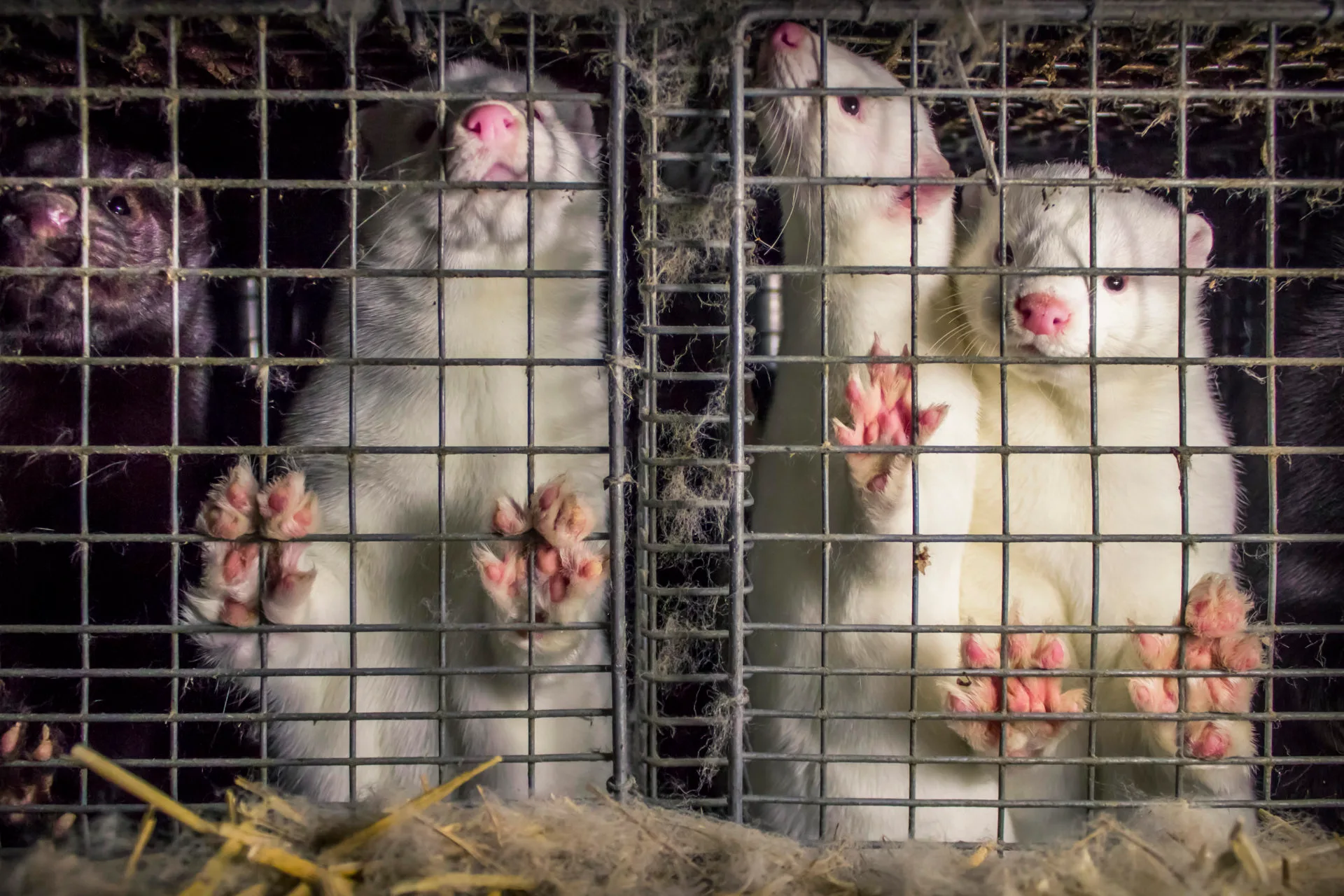
Mink in a cage. Source: Fur Free Alliance
The weakness that you can’t control
Brings animals death and pain
The struggle I fought to overcome
Is the dark pit where you choose to remainEarth Crisis — “All Out War” (1992)
In the sweltering summer days of June 22 and July 17, 1996, thousands of animals fled farms in Salt Lake City. These animals were mink, a word perhaps more known as a synecdoche for mink fur coats.
As one would expect from an industry dedicated to the wholesale scalping of animals for the use of their parts in the fashion industry, these mink ranches are factory farms by another name. Animal welfare activist Scott Beckstead writes here about the conditions mink live in with painful detail: mink (already a rather small creature) are typically cramped by the dozens into small cages. Deprived of basic living space and other needs, these mink are prone to psychotic behaviors including self-mutilation and cannibalism. Female mink are killed by having their necks snapped; males suffocated with cyanide powder. After a precipitous decline in the demand for mink coats, these ranches tend to be “pelted out”—or, less euphemistically, every last mink is killed and skinned to spare no expense. 1
Beckstead would know a thing or two about mink farming; much of these observations stem from his being raised with his mink-farming grandfather. The Beckstead farm was one of the two that were liberated by members of the Animal Liberation Front, a group of radical vegans that were particularly active in sabotaging various animal product industries in the western United States. The liberation was short-lived, with the majority of mink returned, almost certainly to be slaughtered and turned into accessories. Deseret News detestably mourned the destruction of “breeding information accumulated over decades”, as if the collection of this information could be separated from an inherently murderous industry.
I’ve been consumed by memories of Beckstead in the past six months of my life. Any of my friends can testify to my affinity for radical veganism, Salt Lake City and the history of radical veganism in Salt Lake City. Said history lives on partly in digitized newspapers and local legend. My friend Derek up there recently introduced me to the band Lifeless, immortalized for frontman Alex Slack’s connection to the Animal Liberation Front. The ALF, at least in 1990s Salt Lake City, had particularly strong roots in the local vegan straight edge hardcore scene, which was of particular interest to me. Every time in the past few months that I introduced Lifeless to my friends, I would usually follow it up with some variation of “the vocalist was arrested for bombing a mink factory in the 1990s.”
Except that’s not necessarily true. While writing up this article, I realized I had mixed up my memory of radical vegan bombings in 1990s SLC. Slack was arrested and charged with federal crimes for a separate incident: the March 11, 1997 bombing of the Utah Fur Breeders Agricultural Cooperative. The bombing caused up to $1 million in damages to the facility—a nexus of the mink farming industry that still dominates Utah—all while not harming a single one of the workers or the 300 mink that were at the farm. It was described as “the fur industry’s darkest hour”. Slack was detained and, after some of his friends and co-conspirators had begun co-operating with federal law enforcement under duress, took his own life two years later.
My prefacing of this article with some arcane lore on the history of radical veganism in Salt Lake City isn’t an endorsement of domestic terrorism. As a representative of KAMP Student Radio, it would be nothing short of irresponsible and counterproductive to endorse these positions so publicly. I bring these examples up to underline how absurdly veganism has been mischaracterized in the popular imagination by nonvegans.
This article will be a bit different from my past ones here. I won’t argue for the many reasons I am vegan, like how animal agriculture drives a third of global greenhouse emissions and is a threat to 86% of species at risk of extinction. What I will do is give my perspectives on some of the silliest arguments against vegans or veganism that I’ve had the misfortune of getting dragged into this past month or so.
Is this a constructive opinion post or am I just screaming angrily at the wind? I’m not entirely sure myself. I’m an intensely political person, and no other opinion of mine has ever been so contested by so many of the people in my life than this. But my conception of veganism is tied to my conception of straight edge: if it is for myself, it is meaningless. If even one person in my life changes their consuming habits, if even they decide to go a few days without red meat or to swap out whole milk for oat milk, I think it will be worth it.